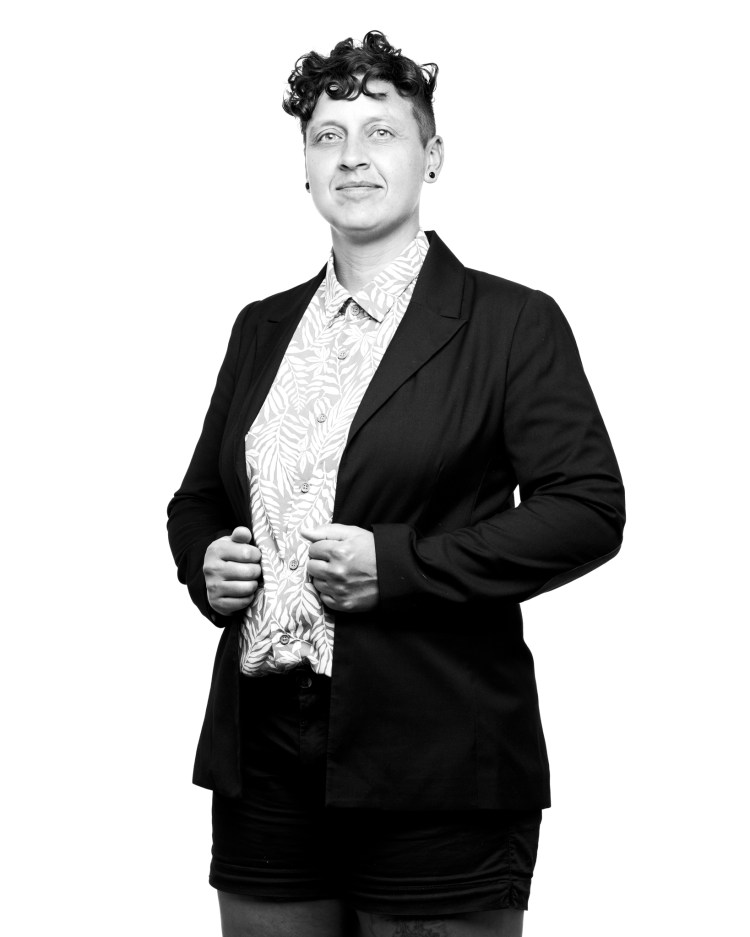
Dr. Jess Whatcott (they/them) is a teacher, writer and organizer based in San Diego, California (Kumeyaay land), working towards carceral abolition, disability justice, queer and trans liberation, and a world without borders.
(Photograph description: A black and white photograph of a white, non-binary person with short curly hair wearing a black jacket over a floral shirt and shorts, smiles into the camera. They are in front of a white background. By Rich Soublet. )
Dr. Whatcott is an Associate Professor of Women’s, Gender, and Sexuality Studies. They are an affiliate of the LGBTQ+ Studies program, the Center for Comics Studies, and the Digital Humanities Initiative at San Diego State University. They teach undergraduate classes on US history and trans studies, and advanced undergraduate and graduate courses on feminist disability studies, abolition feminism, and queer comics. They hold a PhD in Politics, with emphases in Feminist Studies and Critical Race & Ethnic Studies, from University of California Santa Cruz.
Dr. Whatcott studies carceral and eugenicist state violence. Currently, Dr. Whatcott is researching the history of disability restriction in US immigration law, a project that was motivated by their great uncle’s Jaap’s story of being denied a visa to immigrate to the US with his family in the 1950s. Dr. Whatcott places this history alongside the experience of living within sight of the the mass death, mass disablement, and debilitation caused by the US-Mexico border.
Dr. Whatcott’s book Menace to the Future: A Disability and Queer History of Carceral Eugenics theorizes incarceration and disability institutionalization as practices of state-sponsored eugenics. Looking historically at the early twentieth century development of the policy of “segregation” (institutionalization) in California, the book examines state hospitals, state homes for the feeble-minded, reform schools, and reformatories for girls and women from the turn of the century to World War II. Drawing on archival, public policy, literary, visual, and museum research, the manuscript theorizes carceral eugenics and makes links with current practices within the criminal legal system. The book uncovers how disabled, mad, neurodivergent, and queer people locked California institutions enacted abolitionist practices of anti-eugenics in the decades before organized self-advocacy and psych survivors movements.
Elsewhere, Dr. Whatcott has written about speculative fiction, including the stories of Octavia Butler (and here) and Ursula K. Le Guin, and television shows like Orphan Black. Dr. Whatcott looks to pop culture as a site for political education about state violence, eugenics, and neoliberal precarity — past and present. They locate in speculative creations both a diagnosis of “the crisis” and the imagination of transformative abolitionist queer and crip futures.
Dr. Whatcott has been an abolitionist organizer for over 20 years. From 2003-2011, they were part of the Bar None collective working in solidarity with people incarcerated in solitary confinement in far north California. They worked with youth to dismantle zero tolerance policies at schools. They were part of groups/communities responding to sexual violence and learned about the principles and practices of transformative justice. They contributed briefly to Sin Barras (Santa Cruz) and Decarcerate Alameda. From 2020-2024, they were part of the Detention Resistance collective and Free Them All San Diego working in accompaniment with people detained in the borderlands of southern California. They are excited to be part of the 2025 revival of Bar None, this time in San Diego.
Dr. Whatcott’s teaching, research, and organizing is shaped by their experiences as a white, queer, nonbinary, neurodivergent (autistic) person with invisible impairments/chronic illness, from a working-class family and a religious, politically conservative community.


 Dr. Jess Whatcott